I
Draft
Pick one of three
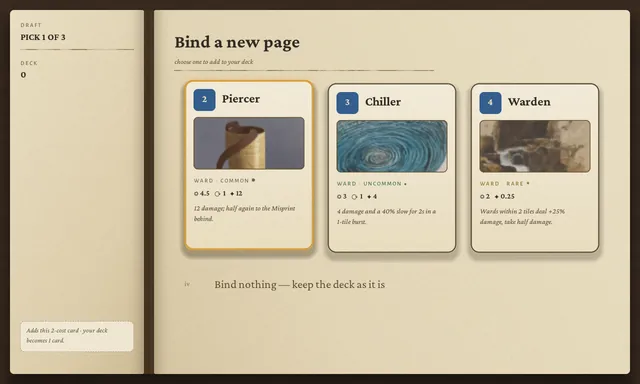
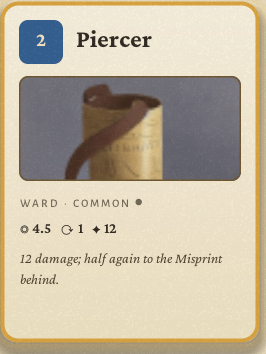
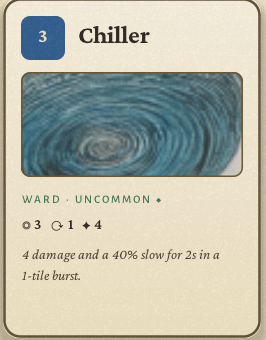
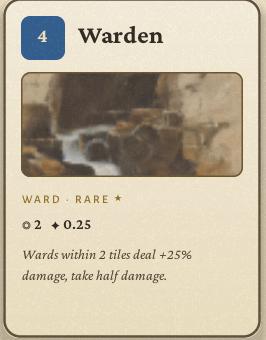
Every offer shows its numbers before you commit — cost, range, rate, damage, rarity and what it actually does. Draft a deck that answers the chapter you are in, or gamble on the one you are not.
PC (Windows) · Nintendo Switch
The deck is the defense.
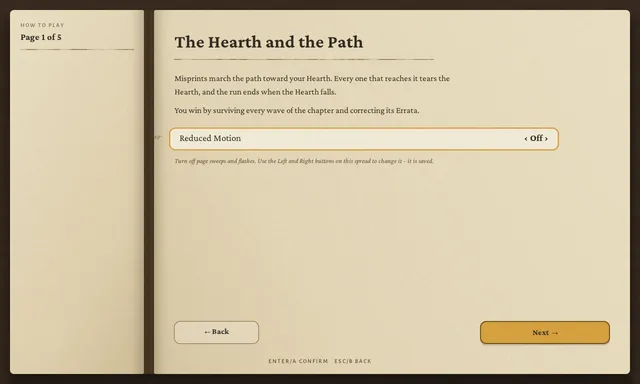
Misprints are marching the path toward your Hearth. Draft your cards, raise your Wards and hold every wave in a real-time tower defense fused with a roguelike deck-builder.
One loop, two clocks
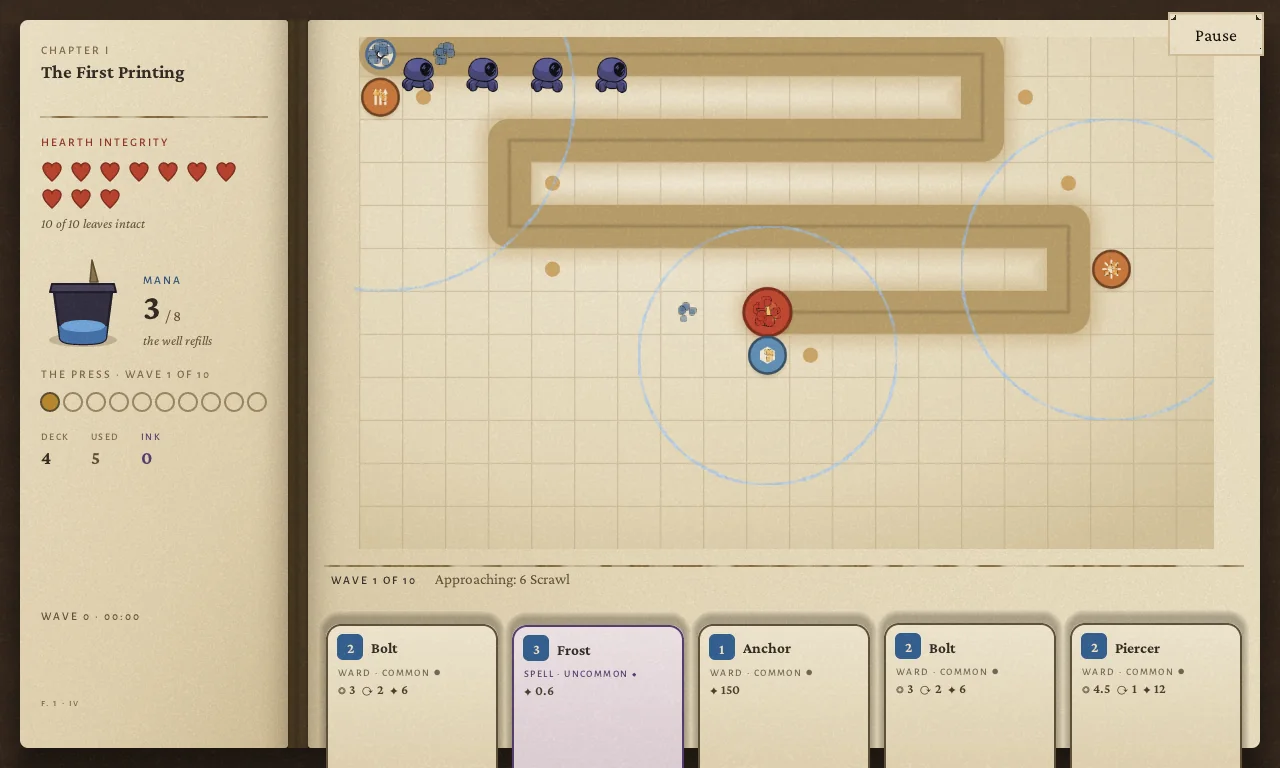
Ink is the build phase: spend it on cards, upgrades and removals while the road is quiet. Mana is the combat phase: it refills at the start of every wave and buys the Wards and Spells you play in real time. Clear a wave and you earn more Ink. Let one Misprint reach the Hearth and you lose integrity — let the Hearth fall and the run is over.
I
Draft
Every offer shows its numbers before you commit — cost, range, rate, damage, rarity and what it actually does. Draft a deck that answers the chapter you are in, or gamble on the one you are not.
II
Place
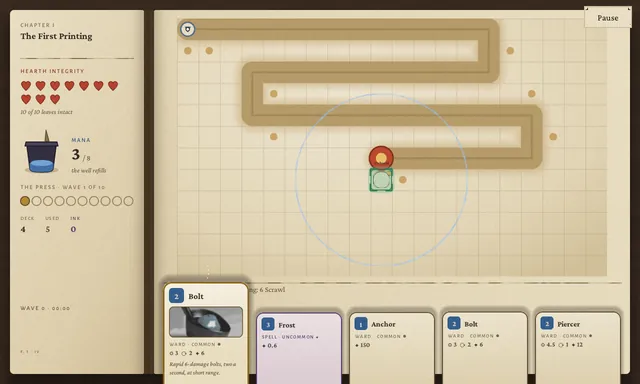
Wards go on the lit tiles beside the path; anchors go on the path itself. Mana refills each wave, so a board that costs everything is a board you cannot repair — click, drag or drive it all with a pad.
III
Defend
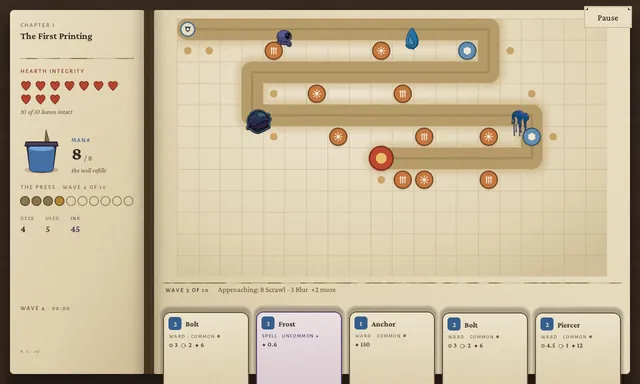
Wards fire on their own. Spells are the answer you choose in the moment: Smite, Frost, Reroute, Banish, Ink Bomb, Overclock. Power-Ups bolt onto one of your own Wards and stay for the whole run.
The deck is the defense
Wards hold the road. Spells answer a moment. Power-Ups bolt onto a Ward for the rest of the run. Relics and Modifiers bend the rules, Economy cards buy you the next wave, and combo tags reward drafting two ideas that were meant for each other.
Piercer, Bolt, Splasher, Chiller, Bleeder, Anchor, Sentry, Warden, Scouter, Sniper, Beacon, Forge-Ward. Each is a stat line you can plan around — and every one upgrades.
Damage, control, redraw, tempo. Aim at a lane, a pack or a single target; the game tells you plainly when a cast has nothing to do.
Inkwell, Grimoire, First Page, Patchwork, Editor's Quill. Stack them and a fair build turns into a broken one.
Between waves
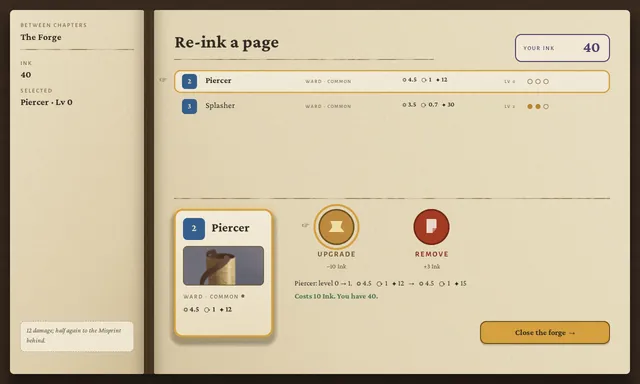
Spend Ink to push a Ward to a higher level, or melt one down for a partial refund when the board has outgrown it. Three starting decks set the tone — The Printer's Kit (balanced), Bulwark (hold the road) and Ink & Fire (spells first) — and six archetypes carry you from there: swarm-burn, slow-and-burn, ranged-poke, economy-overflow, spell-burst and wall-and-harvest.
Eight traits, eight answers
The storybook is printing itself wrong, and each error marches differently. Nine of them will not save you against the tenth — so the deck you draft has to cover the road, not just the wave in front of you.
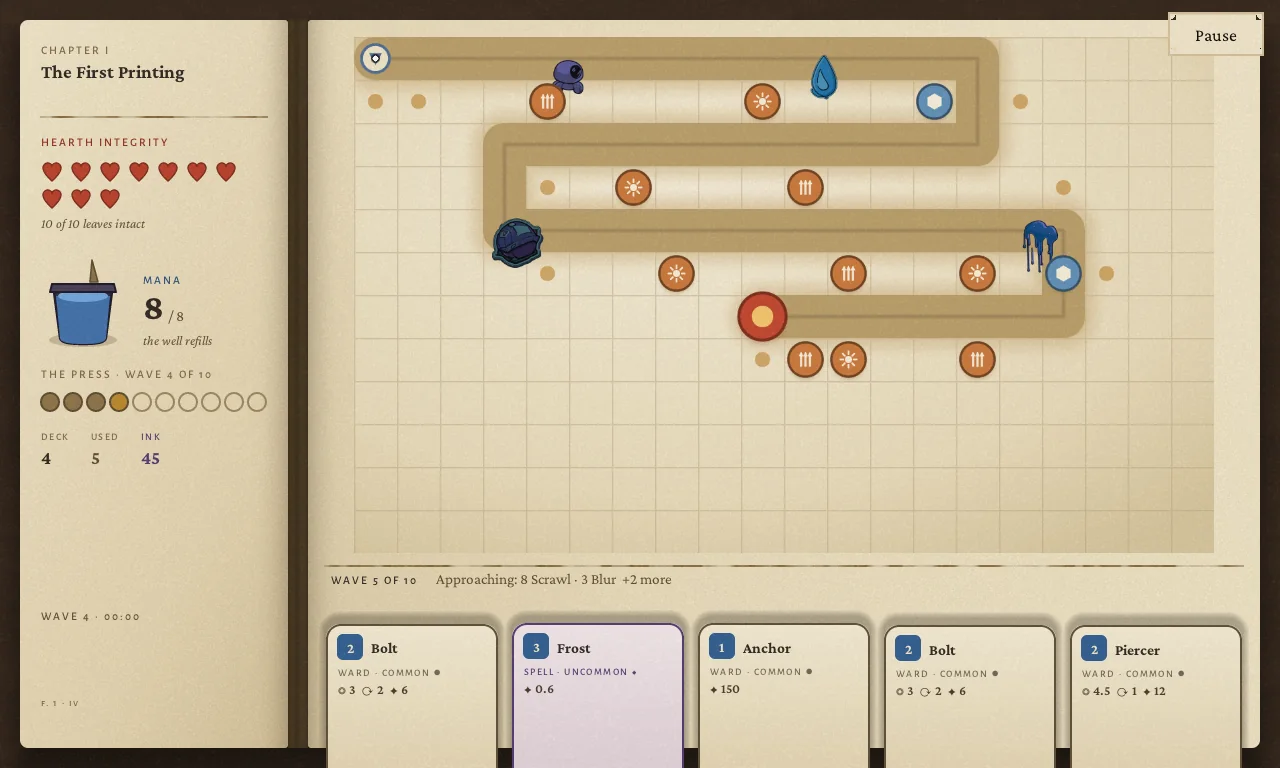
Errata
Each chapter closes on an Errata with its own mechanic: a damage window, a path that folds under your build, four phases that escalate, and finally the page that was never written.
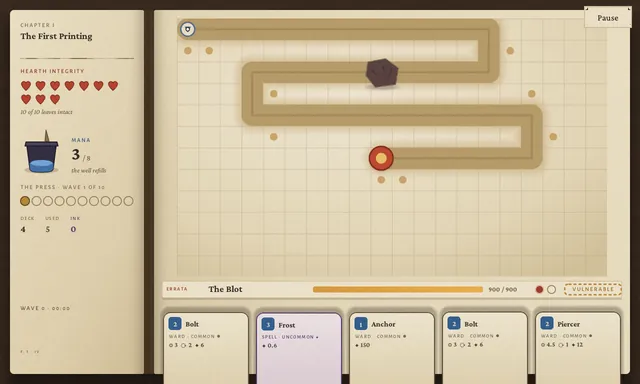
Chapter One. Soaks the road and opens a vulnerability window — everything you saved for that window is everything you get.
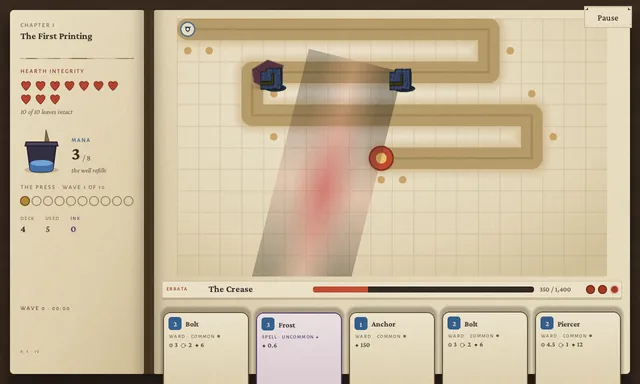
Chapter Two. It folds the path and re-routes the wave. The board you built is suddenly the wrong shape, and support Wards are how you survive that.
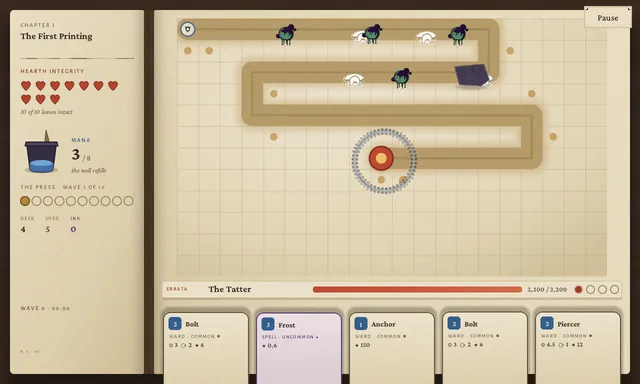
Chapter Three. Four phases, 2,200 HP, and telegraphed hazards dropped on the tiles you are standing on. Bring answers, not just damage.
Sealed until the book is bound
The Deep Deck finale, unlocked when the campaign is bound. No page describes it in the Codex — you have to reach it.
Roguelite campaign
Each chapter is its own board, its own wave table and its own Errata. Pick your difficulty before you pick your deck — Relaxed, Normal, Hard, Brutal, Nightmare or Deep Deck — and every clear pays Ash, the meta-currency that unlocks new cards, relics and roads for the next run.
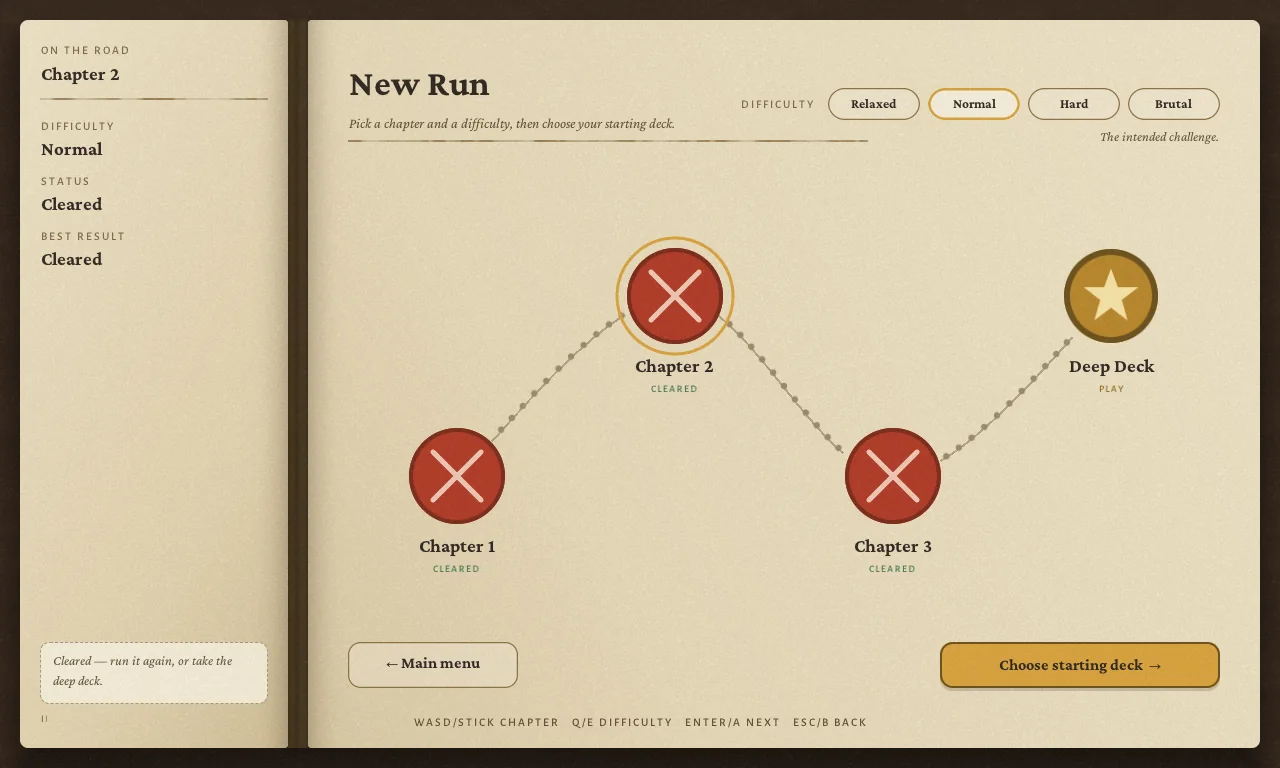
Clean, careful and untouched each score separately, so a safe clear and a flawless one are not the same record.
Losing still pays. Ash unlocks cards, relics and chapters across three profile slots.
Untorn Margin, Not a Drop, The Silent Hand, The Corrector — plus two the menu will not name.
Pick the tier before the deck. Brutal and Nightmare pull the hard traits forward; Deep Deck is the finale.
Same seed, same twists, everyone
One run per day, generated from the date: the same seed and the same two or three modifiers for every player, with a fully unlocked draft pool so nobody starts behind. Enemy HP up, no Forge, extra starting Ink — draw your hand and deal with it.
One seeded stream drives every spawn, offer and drop. A run is reproducible, and a shot at it can be shared.
Every run prints a short code. Hand it to a friend, or type one in and play their exact offer.
Three book skins, three Ward auras and three card backs, bought with Ash.
Eight Misprints and four Errata, documented as you meet them — and only then.
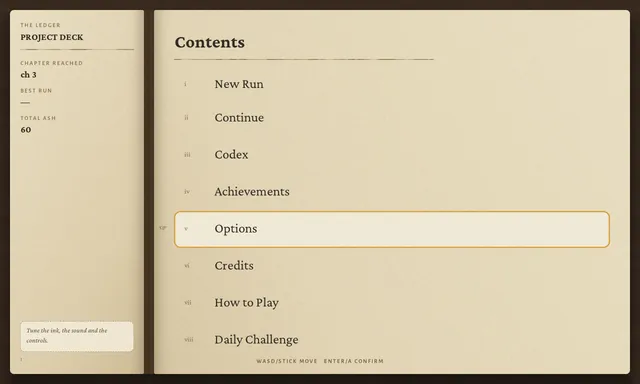
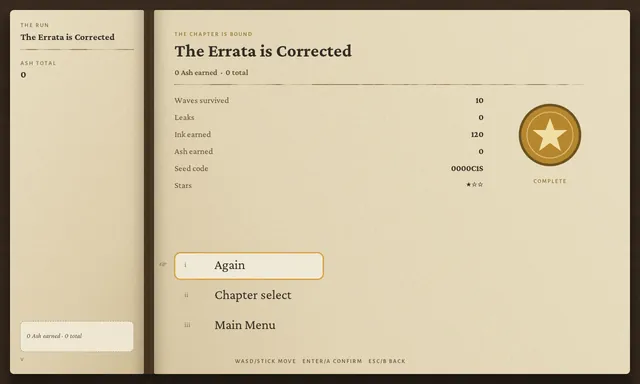
Built to be read
The whole game is driven from a gamepad — menus, board, targeting and all — and everything you need to make a decision is printed on the card.
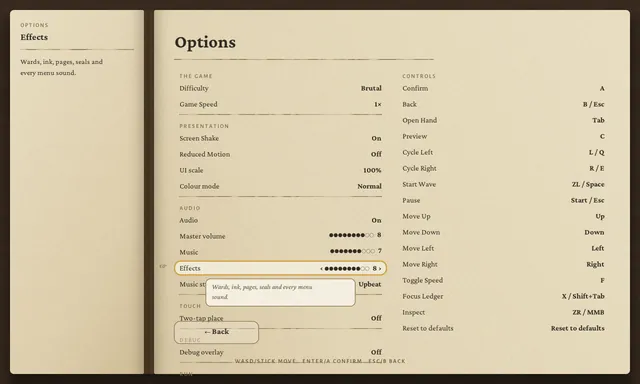
Normal, deuteranopia, protanopia, tritanopia and high contrast.
Turn the screen shake down, or off entirely.
Focus a card to read it at size, and scale the whole interface.
Menus, board, targeting and all — no mouse required, two pads supported.
Screenshots
No mock-ups, no painted concepts — every frame below was captured from the running game on PC at 1280 × 768. Click any of them for the full size.
The deck is the defense.
Three chapters, sixty-one cards, four Errata and a Hearth that will not hold itself. Coming to PC (Windows) and Nintendo Switch.